A research project of the SNF Agora Institute at Johns Hopkins University

Mapping the
modern agora.

A democracy is only as strong as its agora. Mapping the Modern Agora uses computational social science to begin to chart the landscape of American civic infrastructure — county by county, organization by organization — so that the places where people gather, deliberate, and act together can finally be seen at scale.

1.7M Nonprofit organizations classified
3,126 U.S. counties measured
15 Organizational types identified
5 Civic opportunity quintiles
Scroll
The Project

Civic life, made visible.

Efforts to renew American democracy are often complicated by a simple problem: we cannot see the landscape we are trying to repair. This project aims to help close that gap.

The agora — the ancient gathering place where Athenians argued, debated, and decided together — has eroded in modern America. Most people now lack opportunities to engage with each other in the processes of power-sharing, deliberation, and contestation that make pluralistic democracy possible.

Mapping the Modern Agora applies machine learning and large-scale data analysis to measure civic infrastructure across the United States. Beginning with the IRS registry of every tax-exempt organization in America, we link administrative records to text scraped directly from organization websites, then classify each group by the type of civic opportunity it offers: membership, volunteering, public events, and taking civic or political action.

The result is a county-level civic opportunity index. Although this analysis is limited to formal organizations and can't capture all the nuance of what is happening in a community, we hope that this broad, large-scale view can be a a helpful starting point for deeper inquiry into where the modern agora is thriving, where it is thinning, and where it has all but disappeared. We hope researchers, funders, and organizers will see benefit in using it to identify communities that need investment and to test ideas for strengthening civic life.

1.7M Nonprofits in the underlying registry
450k+ Classified as offering civic opportunity
3,126 Counties scored 1–5 on the index
51 States & D.C. with full coverage
The Interactive Map

Every county, scored.

Click any county to see its civic opportunity score, its rank against other counties in its state and the nation, and a breakdown of the types of organizations that make up its civic life. Switch layers to compare the composite index against the most common type of civic organization in each place.

Click a county to open details
Loading map data
Four Findings

What the data tells us.

Four patterns that emerge once 1.7 million organizations are seen as one map — each one a hypothesis for further inquiry, not a conclusion.

01 Finding No. 1 · The Unequal Distribution

The distribution of civic opportunity in America is unequal.

The map of civic opportunity shown here reveals an unequal landscape. For instance, every county in states like Connecticut fall into the top two quintiles of civic opportunity (4 or 5). By contrast, over 86% of counties in Mississippi fall into the bottom two quintiles (1 or 2).

When we zoom in — here on the right we've focused on Los Angeles County, for instance, and calculated the civic opportunity index by zip code — we see that these disparities exist not only at the county level, but also at more localized levels.

Civic opportunity index by zip code

Los Angeles County, California
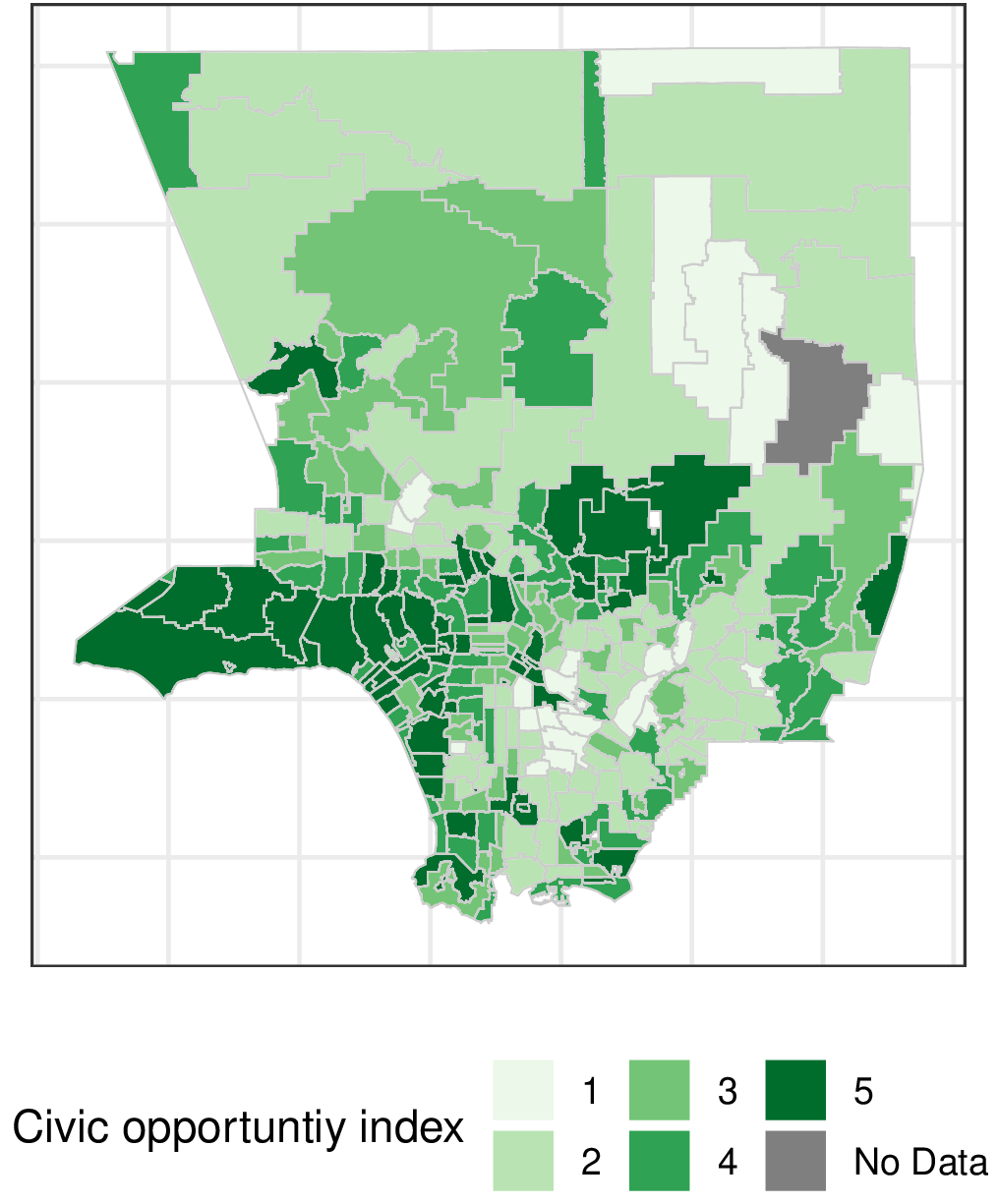
Map of civic opportunity index by zip code in Los Angeles County, showing wide variation from quintile 1 to 5 across neighborhoods
02 Finding No. 2 · The Adversity Gap

Where need is greatest, civic infrastructure is thinnest.

Across every measure of disadvantage tracked in the dataset — poverty, unemployment, single-parent households, the broadband gap, adults without a high-school diploma — the relationship with civic opportunity runs in the same direction: down.

The strongest signal is education. Counties where more adults lack a high-school diploma have substantially fewer civic opportunities per capita — a correlation of −0.45. The places that arguably need the most civic infrastructure to mediate between residents and institutions tend to have the least of it. This is not a coincidence to dismiss; it is a structural finding to address.

Correlation with civic opportunity score

Pearson r across 3,126 counties · negative bars run left

03 Finding No. 3 · The Impact

Where civic opportunity exists predicts where civic action happens.

We also find that this patterned inequality in civic opportunity is related to indicators of a community’s ability to come together to solve shared problems. Communities with limited civic opportunities may lack the necessary infrastructure to take collective action when it is most needed. The emergence of mutual aid in response to the coronavirus pandemic is a good example, as it illustrates people's willingness to take actions that assist their community members.

We found that there's significant connection, at the county level, between civic opportunity and the emergence of COVID-19 mutual aid organizations during the global coronavirus pandemic of 2020-2021 in which counties with higher per capita civic opportunity scores were more likely to have mutual aid organizations emerge during the pandemic. This connection is predicted by our civic opportunity measure, but not by other common measures of community health such as social capital.

The association between civic opportunity and the emergence of mutual aid

COVID-19 mutual aid hubs and civic opportunity per county

Regression between civic opportunity and the emergence of COVID-19 mutual aid instances, controlling for urbanicity, partisanship, poverty, education, and race
04 Finding No. 4 · The Composition

The organizations holding civic life together are changing.

One potential reason civic opportunity may have become so uneven is because there is a mismatch between the types of organizations producing civic opportunity and the types of organizations that get public attention. In our data, the most common organizations provid- ing civic opportunity across America are Social & Fraternal organiza- tions (Rotary Clubs, fraternities, sororities, ethnic clubs and so on) and Religious (churches, temples, mosques and so on) organizations. In 85% of counties, they are the top providers of civic opportunity.

Yet, the landscape of civic opportunity providers has shifted. Social-fraternal and religious organizations went from 62% of civic opportunity providers among organizations founded before 1960 to 28% among those founded after 2010. In addition, the kinds of organizations providing civic opportunity in communities are strikingly different from those represented in Washington DC.

Sources of Civic Opportunity

Historical shift and comparison to Wasington D.C.
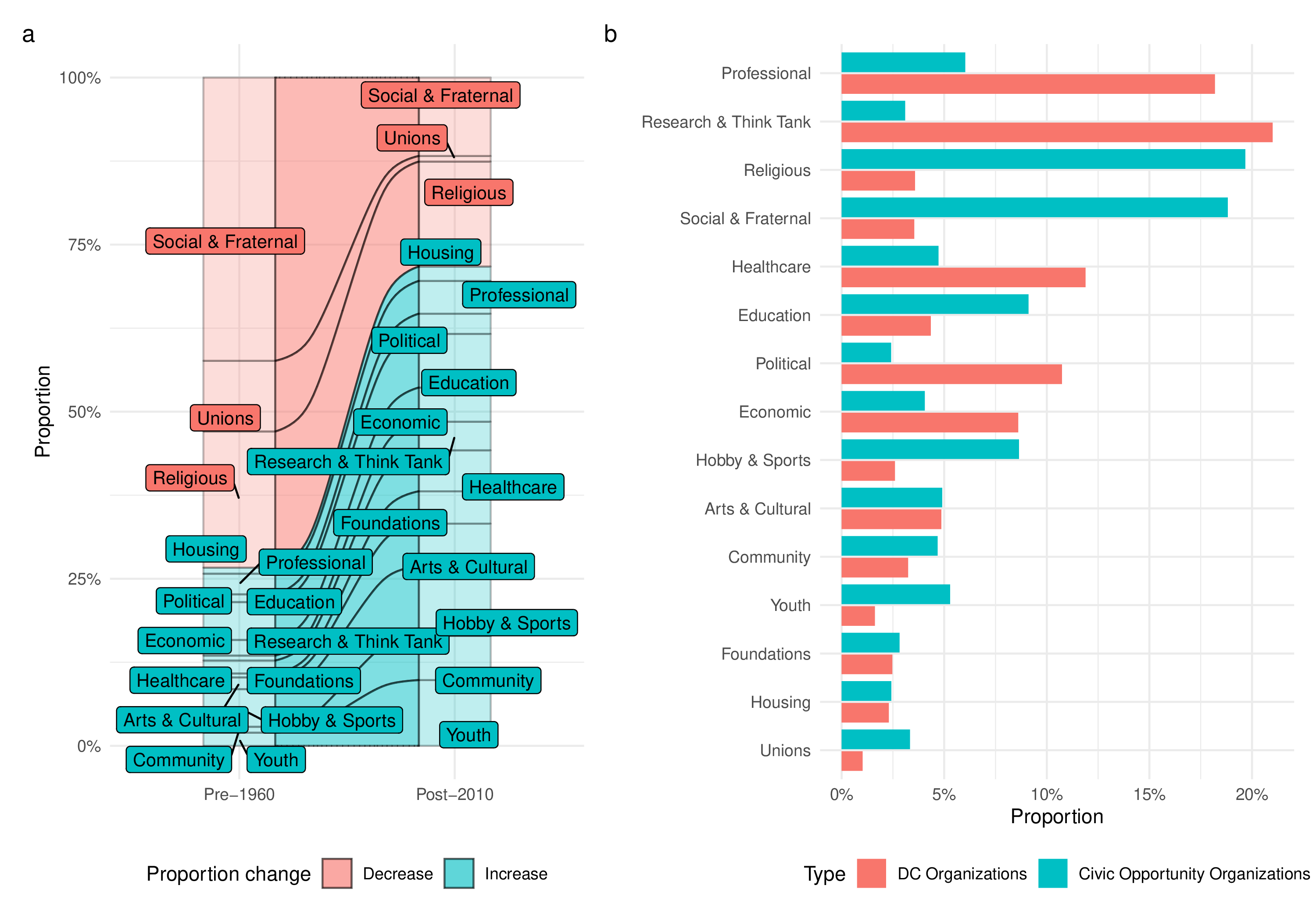
Categories of organization providing civic opportunities by founding year and location.
How It Was Built

Methods & data access.

From a federal registry of nearly two million nonprofits to a per-capita score for every county — a three-step pipeline of administrative data, web scraping, and machine learning.

i.

Start with the registry

The pipeline begins with the IRS Exempt Organizations Business Master File — a comprehensive registry of every tax-exempt organization in the United States, including the many small groups that never file an annual return.

ii.

Scrape the websites

Each organization's website is located and scraped. Natural language processing extracts mission statements, program descriptions, and signals of activity, adding rich text where the IRS has only an address.

iii.

Classify and aggregate

Machine-learned classifiers tag each organization by type and by the civic opportunities it offers. Counts are aggregated to the county level, normalized per 100,000 residents, and binned into a five-point index.

Selected Publications

From the research team.

Three peer-reviewed papers that trace the project from its conceptual roots through its empirical findings to the public release of its underlying datasets.

2025
MapAgora: Civic Opportunity Datasets for the Study of American Local Politics and Public Policy
Jae Yeon Kim, Milan de Vries, Hahrie Han · Nature Scientific Data
Read
2023
The Unequal Landscape of Civic Opportunity in America
Milan de Vries, Jae Yeon Kim, Hahrie Han · Nature Human Behaviour
Read
2022
Civil Society, Realized: Equipping the Mass Public to Express Choice and Negotiate Power
Hahrie Han, Jae Yeon Kim · The ANNALS of the American Academy of Political and Social Science
Read